Washdown & Sanitary Conveyors: Design and Components
Washdown and Sanitary Conveyors: What Makes a Conveyor Truly Washdown-Ready?
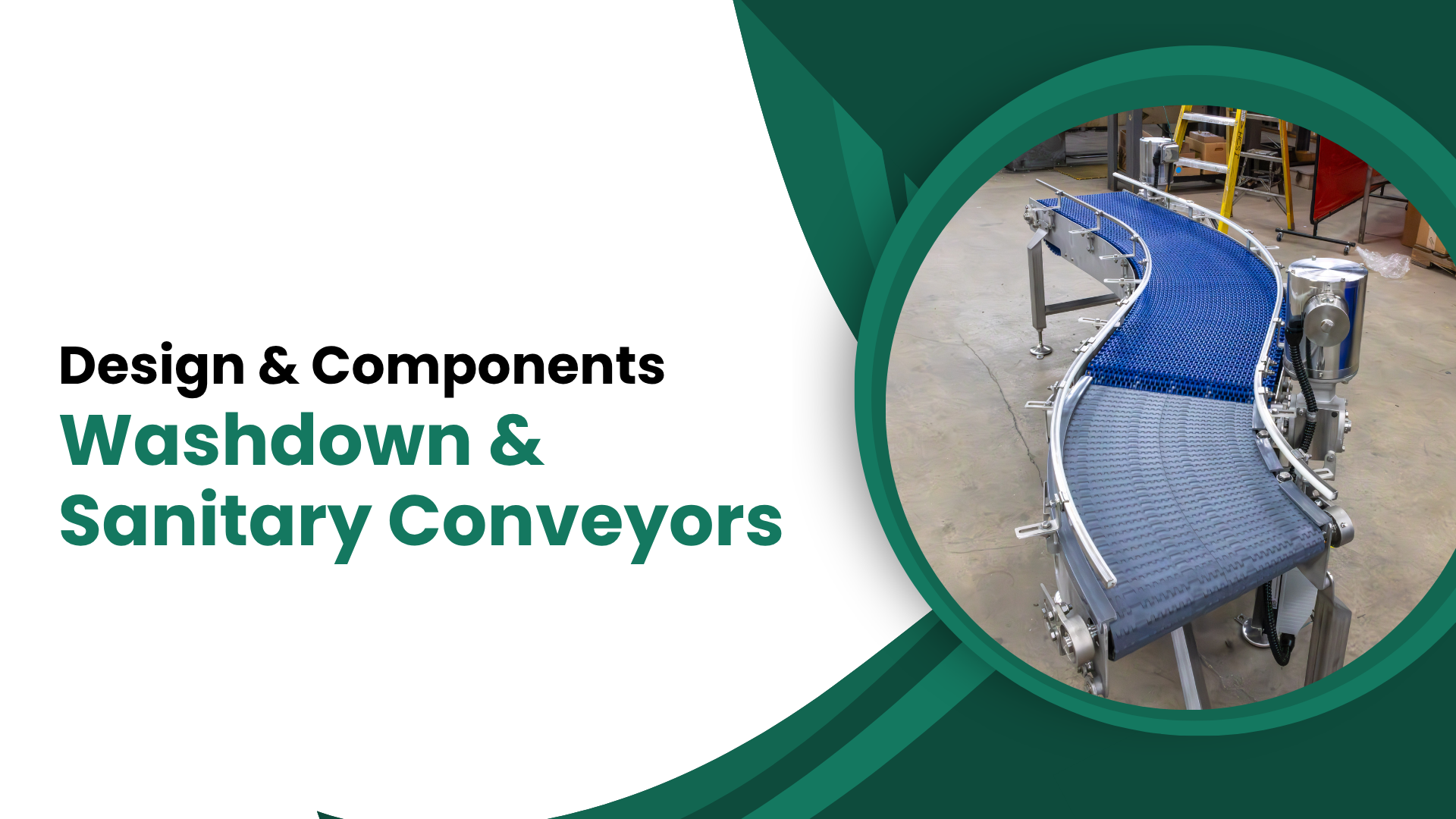
A washdown conveyor is more than a stainless steel frame. To perform reliably in food, beverage, pharmaceutical, and other sanitation-sensitive environments, the entire conveyor has to be designed around cleaning, drainage, corrosion resistance, and contamination control. That includes the welds, frame geometry, gearbox, motor, bearings, belting, fasteners, and access for sanitation. We design and build sanitary conveyors with those details in mind, using welded stainless steel construction and washdown-rated components to help facilities clean more effectively, reduce harborage points, and stand up to repeated exposure to water and cleaning chemicals.
What Is a Washdown Conveyor?
A washdown conveyor is designed to withstand regular cleaning with water, detergents, sanitizers, and, depending on the application, high-pressure or high-temperature spray.
These conveyors are common in environments where product residue, allergens, oils, moisture, or other contaminants need to be removed frequently. Food and beverage processing is one of the most common applications, but washdown conveyors can also be used in pharmaceutical, cosmetics, chemical, marine, and other demanding environments.
The difference between a standard conveyor and a true washdown conveyor is not simply the material used to build the frame.
A conveyor can be stainless steel and still be difficult to sanitize if it contains crevices, unsealed joints, inaccessible bearings, flat surfaces that hold water, or electrical components that are not designed for the cleaning process.
A washdown-ready conveyor has to be considered as a complete system.
Related Article: Understanding SQF Certification for the Food Industry
Sanitary Conveyor Design Starts With Cleanability
For sanitary applications, the question is not just whether the conveyor can get wet.
The more important question is:
Can the conveyor be cleaned thoroughly, inspected easily, allowed to drain, and returned to production without creating hidden contamination risks?
That changes the way the system should be designed.
Depending on the application, a sanitary conveyor may need:
- stainless steel construction
- continuous sanitary welds
- open and accessible frame geometry
- sloped or self-draining surfaces
- minimal horizontal ledges
- reduced hollow members and enclosed spaces
- removable or accessible belting
- sanitary fasteners where required
- washdown-rated motors and gearboxes
- sealed or protected bearings
- food-grade lubricants where appropriate
- components selected for the facility’s actual cleaning chemicals and procedures
These features work together. One weak component can undermine an otherwise sanitary system.
Why Welding Matters on a Washdown Conveyor
Welding is one of the most important differences between a general-purpose conveyor and a conveyor intended for demanding sanitation environments.
Bolted construction can create joints, overlaps, gaps, and interfaces where moisture and product residue collect. That does not mean every bolted connection is automatically inappropriate, but joints in product and splash zones deserve particular attention.
For sanitary conveyor applications, we favor welded construction where it improves cleanability and reduces potential collection points.
What Is Washdown-Compliant Welding?
For sanitary applications, welding should be designed and finished so the joint does not create unnecessary cracks, pits, voids, sharp transitions, or other areas that are difficult to clean.
Depending on the application, sanitary welding considerations may include:
- continuous welds instead of intermittent or skip welds
- smooth weld transitions
- removal of weld spatter
- elimination of pinholes and crevices
- finishing welds for cleanability
- removing heat tint where appropriate
- sealing areas that could allow water or contaminants into hollow structures
- avoiding overlapping joints that create hidden spaces
In high-hygiene product and splash zones, the goal is a smooth, accessible surface that can be cleaned and inspected efficiently.
This is also why specifying stainless steel alone is not enough. The way stainless steel is cut, joined, welded, finished, and assembled has a major impact on sanitation.
Gearboxes Need to Survive the Cleaning Process Too
The gearbox is easy to overlook because it is often treated as a standard power-transmission component.
In a washdown environment, it is part of the sanitation system.
Repeated exposure to water, cleaning chemicals, moisture, and pressure can damage a gearbox that was designed for a dry industrial setting. Corrosion around the housing, seals, shafts, mounting points, or hardware can eventually affect both reliability and cleanability.
For sanitary conveyor applications, gearbox selection should consider:
- washdown rating
- corrosion-resistant housing and hardware
- shaft and seal protection
- compatibility with detergents and sanitizers
- mounting orientation
- drainage around the gearbox
- ability to withstand the facility’s cleaning process
- lubricant requirements
Stainless steel or other corrosion-resistant gearbox designs may be appropriate where equipment is exposed to frequent cleaning.
The gearbox should also be positioned so sanitation teams can clean around it instead of creating an inaccessible pocket between the drive and conveyor frame.
Washdown Motors and IP Ratings
The motor has to withstand the same environment as the conveyor.
A standard industrial motor may operate perfectly well in a dry manufacturing facility but fail prematurely when subjected to regular washdowns.
Ingress Protection, or IP, ratings help communicate how well an enclosure resists solids and water. Ratings such as IP65, IP66, IP67, and IP69K are commonly encountered in washdown environments.
When selecting a washdown motor, consider:
- water pressure during cleaning
- water temperature
- cleaning frequency
- chemical exposure
- enclosure construction
- shaft seals
- electrical connections
- cable entry points
- corrosion resistance
A higher IP rating is not automatically better for every application. The rating should match the actual cleaning conditions in the facility.
For example, a conveyor that receives a light rinse has different requirements from one that is subjected to high-pressure, high-temperature cleaning several times per day.
Bearings Are a Common Sanitation Weak Point
Bearings are another area where a sanitary conveyor can fall short if standard components are used without considering the environment.
A bearing installation includes more than the bearing itself. The housing, seals, grease, mounting surfaces, fasteners, and surrounding geometry all influence sanitation and service life.
In washdown applications, bearings should be selected to resist moisture ingress and corrosion.
Depending on the application, that may mean:
- sealed bearings
- stainless steel or corrosion-resistant housings
- sanitary bearing housings
- protective seals
- food-grade grease where appropriate
- mounting designs that reduce collection points
- accessible locations for inspection and replacement
One important design consideration is what happens underneath the bearing.
A washdown-rated bearing mounted on a flat plate that traps water can still create a sanitation problem. The surrounding frame geometry matters just as much as the bearing specification.
Stainless Steel Is Important, But It Is Not the Whole Answer
Stainless steel is widely used for sanitary and washdown conveyors because of its corrosion resistance and cleanability.
We use stainless steel extensively in food and beverage conveyor systems, particularly where equipment is exposed to water, food residue, cleaning chemicals, or regular washdowns.
But stainless steel alone does not create a sanitary conveyor.
You also need to consider:
- grade of stainless steel
- surface condition
- weld quality
- fastener design
- hollow versus open structural members
- drainage
- component compatibility
- cleaning access
A conveyor with the right material but poor geometry can still hold water, trap debris, and make sanitation more difficult.
Drainage Is Part of Sanitary Design
Water should have somewhere to go.
Flat surfaces, horizontal tubing, boxed-in sections, poorly positioned brackets, and recessed mounting areas can all create puddling after a washdown.
Those areas can increase drying time and create places where soil or microorganisms may remain protected from cleaning.
Sanitary conveyor design often uses:
- sloped horizontal surfaces
- rounded or angled members
- open frames
- self-draining geometry
- minimized ledges
- capped or eliminated open tube ends
- strategic equipment placement
When we design washdown conveyors, drainage is part of the system design, not an afterthought.
The Conveyor Belt Has to Match the Sanitation Requirement
Belting deserves the same level of attention as the frame and drive components.
Different washdown applications may call for:
- plastic modular belts
- monolithic belts
- tabletop chain
- stainless steel belts
- specialty food-grade belting
The best choice depends on what is being conveyed, required transfers, temperature, cleaning chemistry, sanitation risk, and how easily the belt needs to be removed or accessed.
Monolithic belts, for example, can offer a smooth surface with fewer joints and potential harborage points. Plastic modular belts can provide flexibility and serviceability but contain more joints and hinge areas that need to be considered during cleaning.
The right belt is the one that fits both the production process and the sanitation process.
Related Video/Article: Choosing the Right Conveyor Belt: A Guide to Belt Types
Sanitary Conveyors and SQF Requirements
For food manufacturers operating under SQF, sanitation goes beyond routine cleaning.
Equipment needs to support the facility’s broader food safety system, including hazard prevention, sanitation, maintenance, allergen control, inspections, and documented procedures.
Conveyor design can directly affect how easily a facility can:
- clean equipment
- verify cleanliness
- access product-contact areas
- prevent standing water
- reduce potential harborage points
- complete allergen changeovers
- maintain equipment without introducing new contamination risks
A conveyor does not earn a facility SQF certification by itself, but good sanitary design can make it much easier to support the cleaning, inspection, maintenance, and food safety procedures required within an SQF program.
Washdown Conveyors for Food and Beverage Manufacturing
Food and beverage plants are among the most demanding conveyor environments because equipment may be exposed to:
- raw food products
- oils and fats
- sugar
- flour and powders
- proteins
- allergens
- moisture
- temperature changes
- cleaning chemicals
- repeated washdown cycles
The conveyor needs to handle the production process and the sanitation process.
That is why specifying components based only on operating load or conveyor speed is not enough
During conveyor design, we also want to understand how the facility cleans.
Questions may include:
- How frequently is the conveyor washed?
- Is cleaning low-pressure or high-pressure?
- Is hot water used?
- What sanitizers and detergents are used?
- Is foam cleaning part of the process?
- Does the line need to be disassembled?
- How quickly does production need to restart?
- Are there allergen changeovers?
- Which areas are product contact, splash, or non-product zones?
What to Specify When Requesting a Sanitary Conveyor
When requesting a quote for a washdown or sanitary conveyor, provide as much information about the cleaning environment as you do about the product being conveyed.
Helpful details include:
- product type
- direct food contact or packaged product
- conveyor dimensions
- throughput
- belt requirements
- cleaning frequency
- cleaning chemicals
- washdown pressure
- washdown temperature
- required IP or NEMA ratings
- stainless steel requirements
- sanitation standards or customer requirements
- allergen concerns
- maintenance access
- existing upstream and downstream equipment
If you do not know every specification yet, that is fine. Our team can review the application and help determine what information is needed next.
When Do You Need a Sanitary Conveyor Instead of a Standard Stainless Conveyor?
A standard stainless steel conveyor may be appropriate for a wet or corrosive environment without significant hygiene requirements.
A sanitary conveyor becomes more important when the process requires equipment to be repeatedly cleaned and verified, particularly when exposed product is involved.
Consider a sanitary design when:
- food contacts the conveyor directly
- frequent washdowns are required
- allergens are present
- contamination prevention is critical
- sanitation teams need easy access
- water cannot be allowed to pool
- the facility operates under SQF, HACCP, FDA, USDA, BISSC, or other sanitation programs
- standard components are corroding or failing during washdown
- existing equipment takes too long to clean
The distinction is important because adding a stainless frame around standard dry-environment components does not create a true sanitary conveyor.
Designing the Whole Conveyor for Washdown
A sanitary conveyor is only as cleanable as its hardest-to-clean component.
That is why we look beyond the frame.
The welds need to be cleanable. The motor and gearbox need to survive the cleaning process. The bearings need to resist water and corrosion. The belt needs to match the sanitation risk. The frame needs to drain. The components need to remain accessible.
When those decisions are made together, the conveyor is easier to clean, easier to maintain, and better suited for a demanding washdown environment.
We design and fabricate custom stainless steel conveyors for food, beverage, pharmaceutical, cosmetics, packaging, and other applications where sanitation, corrosion resistance, durability, and cleanability matter.
Let's Talk About Washdown Conveyor
Custom Conveyors for Form Fill Seal Machines
Conveyors for Packaging Lines
Conveyors for Palletizing: What to Look for Before You Build
GET IN TOUCH
We’re looking forward to working with you. Whether you have questions about products or services, our team is ready to help.
Frequently Asked Questions
What makes a conveyor sanitary?
A sanitary conveyor is designed so it can be effectively cleaned, drained, inspected, and maintained. Common sanitary features include stainless steel construction, continuous cleanable welds, open frame geometry, accessible components, appropriate food-grade belting, washdown-rated drives, sealed bearings, and designs that minimize areas where water or product residue can collect.
What is the difference between a sanitary conveyor and a washdown conveyor?
A washdown conveyor is designed to withstand cleaning with water and cleaning chemicals. A sanitary conveyor also addresses cleanability, drainage, harborage points, component accessibility, and contamination-control requirements. Many food-processing conveyors need to be both sanitary and washdown-ready.
What type of motor should be used on a washdown conveyor?
There is no single rating that is best for every facility. IP65, IP66, IP67, and IP69K are among the ratings commonly encountered in washdown environments. The correct rating depends on spray pressure, water temperature, cleaning frequency, and equipment exposure.
What IP rating is best for a washdown conveyor motor?
There is no single rating that is best for every facility. IP65, IP66, IP67, and IP69K are among the ratings commonly encountered in washdown environments. The correct rating depends on spray pressure, water temperature, cleaning frequency, and equipment exposure.
Should sanitary conveyor frames be welded or bolted?
Welded construction is often preferred in sanitation-sensitive areas because it can reduce gaps, overlaps, and crevices compared with conventional bolted frame construction. Continuous cleanable welds are especially important in product and splash zones.
What bearings are used on washdown conveyors?
Washdown conveyors commonly use sealed, corrosion-resistant bearings selected to withstand moisture, cleaning chemicals, and frequent sanitation. Bearing housing design, seals, lubrication, mounting geometry, and accessibility should also be considered.
Do washdown conveyors need stainless steel gearboxes?
The best belt depends on the application. Monolithic, plastic modular, tabletop, and stainless steel belts may all be appropriate depending on the product, transfer requirements, sanitation process, temperature, and cleaning requirements.
What conveyor belt is best for sanitary food processing?
The best belt depends on the application. Monolithic, plastic modular, tabletop, and stainless steel belts may all be appropriate depending on the product, transfer requirements, sanitation process, temperature, and cleaning requirements.
Are sanitary conveyors required for SQF certification?
SQF does not prescribe one specific conveyor design for every facility. Equipment should support the facility’s food safety system, sanitation procedures, hazard controls, maintenance program, and verification requirements. Cleanability, drainage, weld quality, component selection, and accessibility can all affect how well a conveyor supports those requirements.