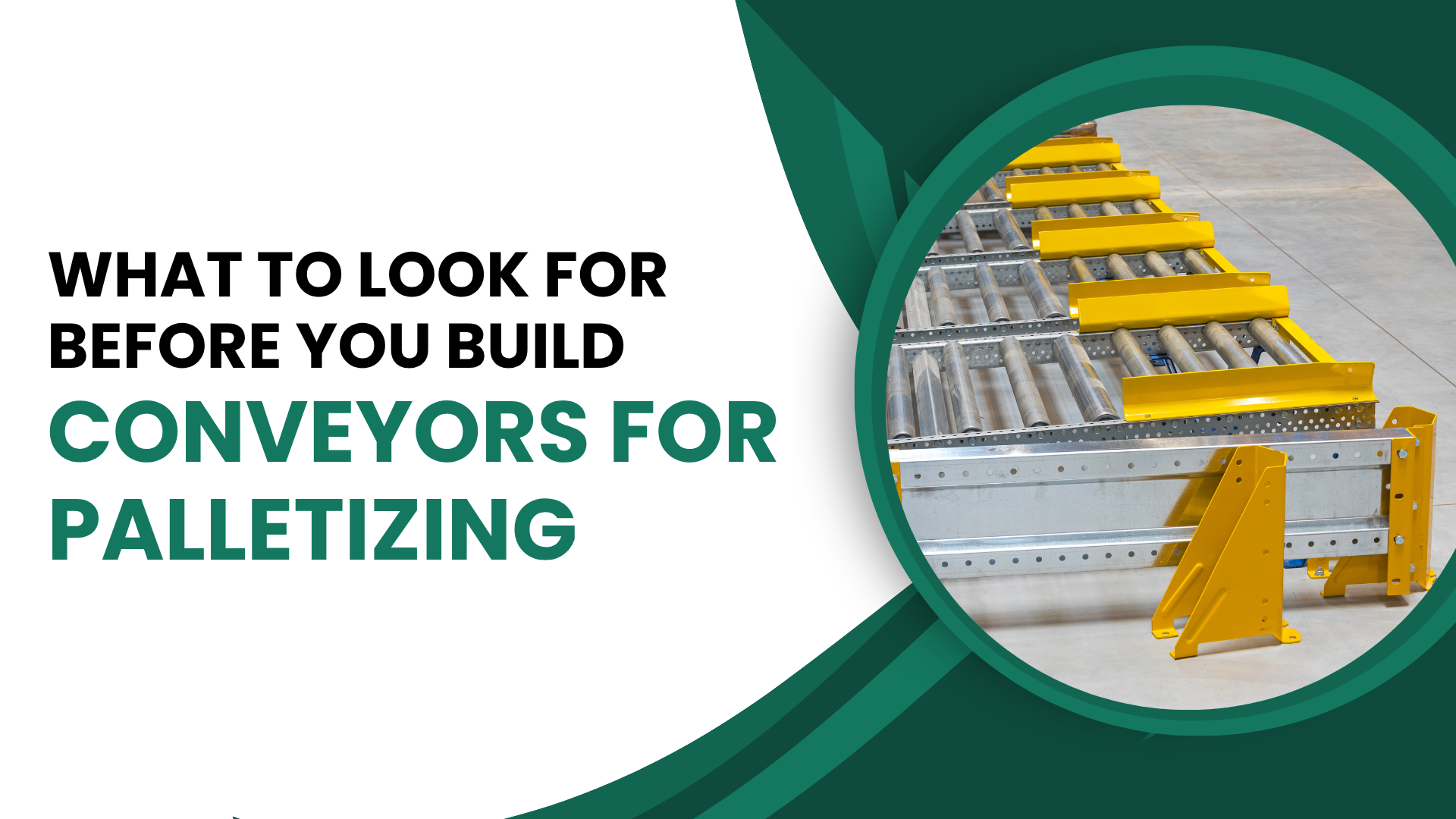
Conveyors for Palletizing: What to Look for Before You Build
Conveyors for Palletizing: What to Look for Before You Build or Upgrade a Line
Sanitary compliance isn’t one rulebook. It’s a stack of programs, standards, and customer requirements that overlap. This quick guide translates what multiple compliances (HACCP, SQF, BISSC, USDA, FDA, etc.) typically mean for conveyor design, installation, and maintenance – plus a field-ready audit checklist you can use on your next walk-throug
Conveyors are a critical part of palletizing performance
When people think about palletizing, they usually picture the robot, gantry, or conventional palletizer. But the conveyor system feeding that equipment often has just as much impact on line performance.
A palletizer can only work as smoothly as the infeed feeding it. If products arrive inconsistently, bunch up, rotate unexpectedly, back up too early, or enter the cell with poor timing, the palletizing system has to compensate. That leads to interruptions, unstable stacks, reduced throughput, and unnecessary operator intervention.
That is why palletizing conveyor design should be treated as part of the palletizing system, not as a simple afterthought.
What palletizing conveyors actually need to do
A conveyor for palletizing is usually responsible for more than basic transport. Depending on the application, it may need to:
- Create proper product gaps
- Maintain case or bundle orientation
- Buffer product before the palletizer
- Handle line surges without crushing or tipping product
- Merge multiple lanes
- Elevate or lower product to the correct working height
- Guide products into a consistent single-file or patterned flow
- Interface cleanly with robotics, sensors, controls, and safety systems
That is one reason custom conveyor work matters so much in palletizing applications. Hanover Conveying Systems already emphasizes custom conveyor solutions for packaging and product handling, including layouts that account for orientation, rotation, elevation, and 90-degree transfer. Those same design considerations are often central to a successful palletizing line.
Common palletizing conveyor challenges
1. Poor product spacing
If cases arrive too close together or inconsistently spaced, the palletizer may not pick or place as intended. This can be especially problematic in robotic palletizing cells that rely on repeatable timing.
2. Product instability
Not every product behaves the same on a conveyor. Corrugated cases, shrink bundles, bags, pails, trays, and totes all respond differently to starts, stops, transfers, and accumulation pressure.
3. Accumulation problems
Too little accumulation can starve the palletizer. Too much poorly controlled accumulation can damage product, increase backpressure, and create jams near the end of the line.
4. Layout constraints
Palletizing is often added to existing plants where space is already tight. That means the conveyor system may need to fit around columns, walls, operator access paths, existing equipment, or elevation changes.
5. Maintenance and sanitation concerns
In some industries, the palletizing area still has to meet strict expectations for cleanability, durability, and service access. Hanover’s site already positions its conveyor work around industries such as food and beverage, pharmaceuticals, packaging and product handling, cosmetics, raw materials, and waste management, all of which can bring different sanitation and maintenance demands.
What to look for in a conveyor system for palletizing
Consistent product control
The best palletizing conveyors do not just move product. They help control it. That means the system should be designed around case size, weight, center of gravity, bottom surface, orientation needs, and required throughput.
Proper accumulation strategy
Accumulation should be intentional. In some lines, low-pressure accumulation is important. In others, a timed release or metered infeed matters more. The right choice depends on the product and the palletizing method.
Smooth transfers
Transfers are often where instability begins. Poorly designed transitions can skew cartons, catch corners, or create product bounce right before the palletizer. Transfer design deserves more attention than it usually gets.
Space-efficient layout
A conveyor system should help the palletizing area fit the building, not force the building to work around the conveyor. Curves, elevation changes, and compact layouts can be important where floor space is limited. Hanover’s trusted partner pages already highlight options like straight, curved, incline, decline, and Z-frame conveyor configurations, which are the kinds of layout tools that often matter in end-of-line design.
Serviceability
Belts, wear components, guides, sensors, and controls should be accessible. A palletizing area is too important to become a maintenance bottleneck.
Integration with the rest of the line
The conveyor feeding a palletizer should not be treated like an isolated island. It needs to match upstream rates, product presentation needs, and downstream pallet handling expectations.
Why custom conveyors matter in palletizing applications
Palletizing is one of the clearest examples of where standard conveyors can fall short.
An off-the-shelf conveyor may be fine for basic transport. But palletizing lines often involve real-world complications such as variable case sizes, merge points, constrained footprints, accumulation zones, product turning, lift points, or the need to feed a robot precisely. That is where a custom approach adds value.
Hanover Conveying Systems positions itself around custom conveyors and fabricated solutions rather than a one-size-fits-all model. On its packaging and product handling page, the company specifically calls out configuring conveyors around space restrictions and motion needs such as orientation, rotation, elevation, standing up, laying down, and 90-degree transfer. That kind of application-based design thinking is exactly what palletizing projects often require.
Industries where palletizing conveyor design matters most
Palletizing is common across many industries, but the conveyor requirements can vary significantly.
Food and beverage
Cleanability, corrosion resistance, packaging variation, and high throughput often matter most.
Pharmaceuticals and nutraceuticals
Product handling may need to be more precise, cleaner, and easier to validate or maintain.
Packaging and product handling
Case flow, orientation, merges, and efficient movement between packaging and palletizing equipment are often the priority.
Raw materials and industrial products
Durability, load handling, and rugged operation can outweigh cosmetic concerns.
Hanover already serves several of these industries through its conveyor and fabrication work, which makes palletizing a natural topic for the brand’s content and project mix.
Signs your current palletizing conveyor setup may need improvement
A new system is not always necessary, but there are some common warning signs that the existing conveyor arrangement is holding the line back:
- frequent product jams near the palletizer
- inconsistent product presentation
- too much operator intervention
- poor accumulation control
- line stoppages caused by transfer points
- unstable product before picking or stacking
- difficult maintenance access
- a layout that wastes valuable floor space
When these issues keep showing up, the problem is often not just the palletizer itself. It is the conveyor strategy feeding it.
A better way to think about palletizing conveyors
The best palletizing conveyor systems are designed as part of the full line, not as a final bolt-on. They account for product behavior, throughput goals, equipment interfaces, sanitation needs, and the day-to-day realities of running a plant.
That is especially important in facilities where uptime, flexibility, and clean integration matter. Hanover Conveying Systems already frames its offering around custom conveyor design, fabrication, and integration for industries that cannot afford a poor fit. For palletizing projects, that same approach can make the difference between a line that constantly needs attention and one that runs the way it should.
Custom Conveyors for Form Fill Seal Machines
Conveyors for Packaging Lines
Conveyors for Palletizing: What to Look for Before You Build
GET IN TOUCH
We’re looking forward to working with you. Whether you have questions about products or services, our team is ready to help.
Frequently Asked Questions
What type of conveyor is best for palletizing?
The best conveyor for palletizing depends on the product, package type, throughput, available space, and palletizing method. Many palletizing lines use a combination of transport conveyors, accumulation conveyors, turns, and custom transfers to create a stable, repeatable infeed.
Why is accumulation important before a palletizer?
Accumulation helps maintain steady product flow to the palletizer and prevents upstream disruptions from immediately starving the end of the line. The right accumulation method also helps avoid excessive backpressure and product damage.
Can a standard conveyor work for a palletizing line?
Sometimes, but not always. Standard conveyors may handle simple transport, but palletizing applications often need custom spacing, controlled accumulation, product orientation, merges, elevation changes, or tight-layout solutions that are better addressed with a custom system.
What problems can a poorly designed palletizing conveyor cause?
Common issues include jams, unstable product, poor case spacing, inconsistent orientation, downtime, operator intervention, damaged packaging, and reduced palletizing efficiency.
What should be considered when designing a palletizing conveyor system?
Important factors include product size and weight, package stability, line speed, accumulation needs, layout constraints, transfer quality, maintenance access, and integration with palletizing equipment and controls.
Can palletizing conveyors be designed for food or pharmaceutical environments?
Yes. In industries with higher hygiene expectations, conveyor materials, construction details, and cleanability become especially important. Hanover Conveying Systems already serves food, beverage, pharmaceutical, and other industries where sanitation and compliance can be part of conveyor design.